How Congressional Districts Work
All information provided on this page has been collected from the various sources published by the Ohio Legislative Service Commission.
Procedure for Drawing General Assembly Districts
General Assembly Districts Procedure for Drawing Districts Under the Ohio Constitution, the seven-member Ohio Redistricting Commission is responsible for dividing Ohio into Senate and House districts. Information about the Commission and its duties is available on its website: redistricting.ohio.gov.
The Commission is composed of the Governor, the Auditor of State, the Secretary of State, a person chosen by the Speaker of the House, a person chosen by the Minority Leader of the House, a person chosen by the President of the Senate, and a person chosen by the Minority Leader of the Senate. No appointed member of the Commission may be a current member of Congress. The Commission meets in each year ending in “1” on a date designated by the Governor. The Commission prepares and adopts a redistricting plan based upon the federal decennial census taken in the preceding year. The Commission is required to adopt the redistricting plan by September 15 and generally must do so by a specified bipartisan vote. Except in certain circumstances, the plan cannot be changed until the next decennial redistricting.
If a federal court or the Ohio Supreme Court invalidates the redistricting plan, the Commission is required to meet and prepare a new plan. A new plan must allow persons 30 days to change residence in order to be eligible for election under its provisions. The new plan generally cannot be changed until the next decennial redistricting.
District Standards
In preparing the redistricting plan for the state House of Representatives and Senate, the Ohio Redistricting Commission first divides Ohio’s population by 99. The resulting quotient is the “ratio of representation” in the House for the next ten years. The Commission then divides Ohio’s population by 33. The resulting quotient is the ratio of representation in the Senate for the next ten years. The Commission then draws lines dividing the state into 33 Senate and 99 House districts.
In drawing district lines, the Commission is subject to the “one person, one vote” principle. Although the goal in drawing district lines under this principle is exact population equality among House and Senate districts, achieving absolute equality is practically impossible and some deviation from the ratios of representation is therefore unavoidable. Consequently, the population of each Senate and House district must be only substantially equal to the applicable ratio of representation, and a Senate or House district cannot contain less than 95% nor more than 105% of the applicable ratio of representation.
In drawing districts, the Commission must follow procedures to keep counties, municipal corporations, and townships together. And, the Commission must attempt to create a district plan that:
- Is not drawn primarily to favor or disfavor a political party
- Corresponds closely to the statewide partisan preferences of Ohio voters
- Includes compact districts
House of Representatives Districts
Ohio House districts must be composed of contiguous territory that is bounded by a single, nonintersecting, continuous line. A county that has a population greater than 105% of the House ratio of representation is entitled to as many House districts wholly within its boundaries as it has whole ratios. (Any fraction of such a county’s population in excess of the whole ratio is to be made part of only one adjoining House district.) A county that has a population between 95% and 105% of the House ratio of representation must be designated a House district. The remaining territory of the state must be divided into House districts by combining counties, municipal corporations, and townships. The Ohio Redistricting Commission must follow rules designed to minimize the number of political subdivisions split under the redistricting plan.
Senate Districts
Ohio Senate districts must be composed of three contiguous House districts. A county that has a population equal to one or more Senate ratios of representation is entitled to as many Senate districts wholly within its boundaries as it has whole ratios. (Any fraction of such a county’s population in excess of the whole ratio is to be made part of only one adjoining Senate district.) Counties having less than one whole Senate ratio but at least one whole House ratio are to be part of only one Senate district.
If a redistricting plan changes the boundaries of an existing Senate district and if a Senator’s term will not expire within two years after the adoption of the plan, the Senator represents, for the remainder of that term, the new Senate district that contains the largest portion of the population of the old Senate district from which the Senator was elected. If more than one incumbent Senator would represent such a new Senate district by following this rule, the plan must designate which Senator is to represent the new district and which district each of the other Senators will represent for the remainder of their terms.
Procedure for Drawing Federal Congerssional Districts
Similarly, Ohio’s congressional districts must be redrawn in each year ending in “1” based upon the federal decennial census. Based on the 2020 census and the resulting reapportionment of U.S. House of Representatives seats by Congress, Ohio has 15 seats in the U.S. House (one fewer than it had under the 2010 census) with an ideal district population of 786,629.
The Ohio Constitution requires the General Assembly to adopt a congressional district plan by a specified bipartisan vote and in the form of a bill by September 30. If the General Assembly does not do so, the Ohio Redistricting Commission must adopt a plan by a specified bipartisan vote by October 31. And, if the Commission does not adopt a plan by that date, the General Assembly must adopt a plan by November 30. Except in certain circumstances, the plan cannot be changed until the next decennial redistricting.
If a federal court or the Ohio Supreme Court invalidates the redistricting plan, the General Assembly has 30 days to pass a replacement plan that remedies the legal defects but includes no other changes. If the General Assembly does not do so by that deadline, the Commission has another 30 days to adopt a replacement plan in the same manner.
District Standards
In preparing the redistricting plan for the U.S. House of Representatives, the authority drawing the districts must divide Ohio’s population by the number of districts apportioned to the state. The resulting quotient is the congressional ratio of representation for the next ten years.
The authority drawing the districts is subject to the “one person, one vote” principle. In general, the district populations must be as equal as practicable. Congressional districts must be composed of contiguous territory that is bounded by a single, nonintersecting, continuous line. The authority also generally must follow procedures to keep districts compact and to keep counties, municipal corporations, and townships together instead of splitting them between districts.
If the General Assembly passes a congressional district plan by a simple majority vote instead of by the specified bipartisan vote, additional district standards apply, including requirements that the plan not unduly favor or disfavor a political party or its incumbents and that the plan not unduly split governmental units.
District contiguity and continuous boundry lines
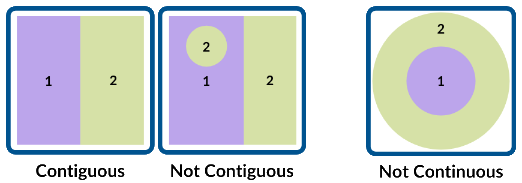 Every congressional and General Assembly district in Ohio must be contiguous, meaning that it is a single, unbroken shape, with no “islands” of territory that do not touch the rest of the district. Each district’s boundary also must be a single nonintersecting continuous line. This standard prevents, for example, the creation of “donut” districts, with one district entirely surrounding another, or a district joined at a single point by an intersecting line.1
Compactness
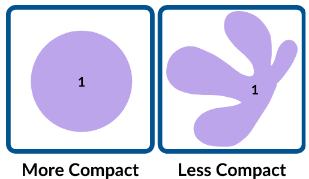
A district is considered compact if it has a minimal distance between all parts of its territory. Multiple methods exist to measure a district’s compactness, such as calculating the total length of its perimeter (a shorter perimeter meaning a more compact district), or calculating the average distance between locations on the outer edges of the district and the center of the district (a shorter average distance meaning a more compact district).
Under the Ohio Constitution, the Ohio Redistricting Commission must attempt to draw compact General Assembly districts, but it is not explicitly required to do so. On the other hand, congressional districts must be compact, except that under the modified district standards that apply if the General Assembly fails to pass a district plan by the required bipartisan vote, the legislature must attempt to draw compact districts, but is not required to.2
Keeping political subdivisions whole
Ohio’s congressional and General Assembly redistricting processes both place a priority on keeping counties, cities, villages, and townships together within one district. Splitting a political subdivision is necessary when, for example, its population exceeds the ideal district population. But, the Ohio Constitution includes procedures to minimize any unnecessary splitting.
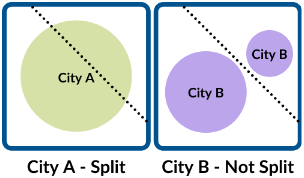
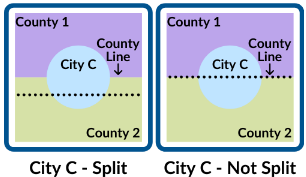
Under both redistricting processes, a political subdivision is considered to be split if any contiguous portion of its territory is not contained entirely within one district. If a political subdivision has an island of territory that does not touch the rest of the subdivision, putting the island in a different district is not considered splitting the political subdivision (see above). Further, if a city, village, or township has territory in more than one county, drawing the district line along the county line is not considered splitting the city, village, or township.3
Packing and cracking
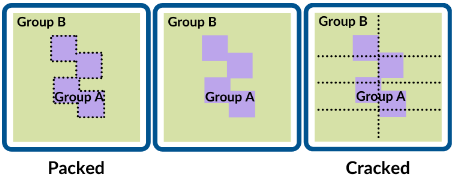
Two district-drawing practices, commonly called packing and cracking, can give one group less influence than another. At one extreme, when a group is “packed” into a single district, it makes up a supermajority within the district, but is less able to influence the outcome of elections outside that district. Conversely, when a group is “cracked” among many districts, it makes up only a minority of the vote in each district, and is less able to influence the outcome of elections in any district. In some redistricting cases, packing and cracking have given rise to claims of unlawful gerrymandering.
Political Considerations
The Ohio Constitution includes two separate standards for the inclusion of political considerations in the drawing of district maps. For a General Assembly district plan, the Ohio Redistricting Commission must attempt to adopt a plan that:
- Not drawn primarily to favor or disfavor a political party
- The statewide proportion of districts whose voters, based on statewide state and federal partisan general election results during the last ten years, favor each political party corresponds closely to the statewide preferences of the voters of Ohio
For a congressional district map, the Ohio Constitution specifies that if, under the impasse procedure, the General Assembly passes a redistricting plan by a simple majority vote instead of by the required bipartisan vote, the plan must not unduly favor or disfavor a political party or its incumbents.4
Majority-minority districts
The Equal Protection Clause of the 14th Amendment and the federal Voting Rights Act of 1965 (VRA) prohibit any district plan from denying or abridging citizens’ right to vote on account of race, color, or status as a member of a language minority group. The U.S. Supreme Court has developed a test to determine whether a district map dilutes minority voting strength in violation of the VRA by cracking a minority population among multiple districts, as described above. Essentially, the test examines whether:
- The minority group is “sufficiently numerous and compact to form a majority in a single-member district
- The minority group is “politically cohesive,” meaning its members tend to vote similarly
- “The majority votes sufficiently as a bloc to enable it ... usually to defeat the minority’s preferred candidate.” 5
In order to remedy a case of minority vote dilution, a court may require the adoption of a majority-minority district, in which a sufficient population of a minority group exists to allow the group to elect its candidate of choice. Currently, no court has expressly required Ohio to create majority-minority congressional or General Assembly districts. A state may draw majority-minority districts voluntarily in order to remedy past discrimination. However, in some circumstances, the courts have overturned plans that included voluntarily created majority-minority districts because creating those districts amounted to unconstitutional racial gerrymandering.6
Other common concepts
The Ohio Redistricting Commission and the General Assembly might consider other district-drawing concepts in creating district maps, so long as the constitutional requirements are met. For example, some states use criteria such as preserving communities of interest in a single district or maintaining previous district lines to the extent feasible.
Cited Sources
- Ohio Constitution, Article XI, Section 3(B)(3) and art. XIX, sec. 2(B)(3)
- Ohio Const., art. XI, sec. 6 and art. XIX, secs. 1(F)(3)(c) and 2(B)(2)
- Ohio Const., art. XI, sec. 3(D) and art. XIX, sec. 2(C)
- Ohio Const., art. XI, sec. 6 and art. XIX, sec. 1(C)(3)(a) and (F)(3)(a)
- 52 U.S.C. 10301; Thornburg v. Gingles, 478 U.S. 30, 50 (1986); and Village of Arlington Heights v. Metropolitan Housing Development Corp., 429 U.S. 252, 264 (1977)
- Voinovich v. Quilter, 507 U.S. 146 (1993); Bush v. Vera, 517 U.S. 952 (1996); Shaw v. Hunt, 517 U.S. 899 (1996); and Alabama Legislative Black Caucus v. Alabama, 135 S.Ct. 1257 (2015)